UNIVERSITY OF WATERLOO · MOBILE ROBOTICS

MPC-Based Path Following
with a Summit Mobile Robot

Experimental implementation of model predictive control for path following using a holonomic Summit mobile robot and Vicon motion-capture feedback.

Project Overview

From controller design to physical robot experiments

This work focused on implementing and experimentally evaluating model predictive control for path following on a real holonomic mobile-robot platform.

Summit Holonomic mobile robot
Vicon External pose feedback
MPC Path-following controller
Physical Experimental validation
Experimental Platform

Summit mobile robot in a Vicon-instrumented environment

The experimental platform combined a holonomic Summit mobile robot with an external Vicon motion-capture system for real-time pose measurement during path-following tests.
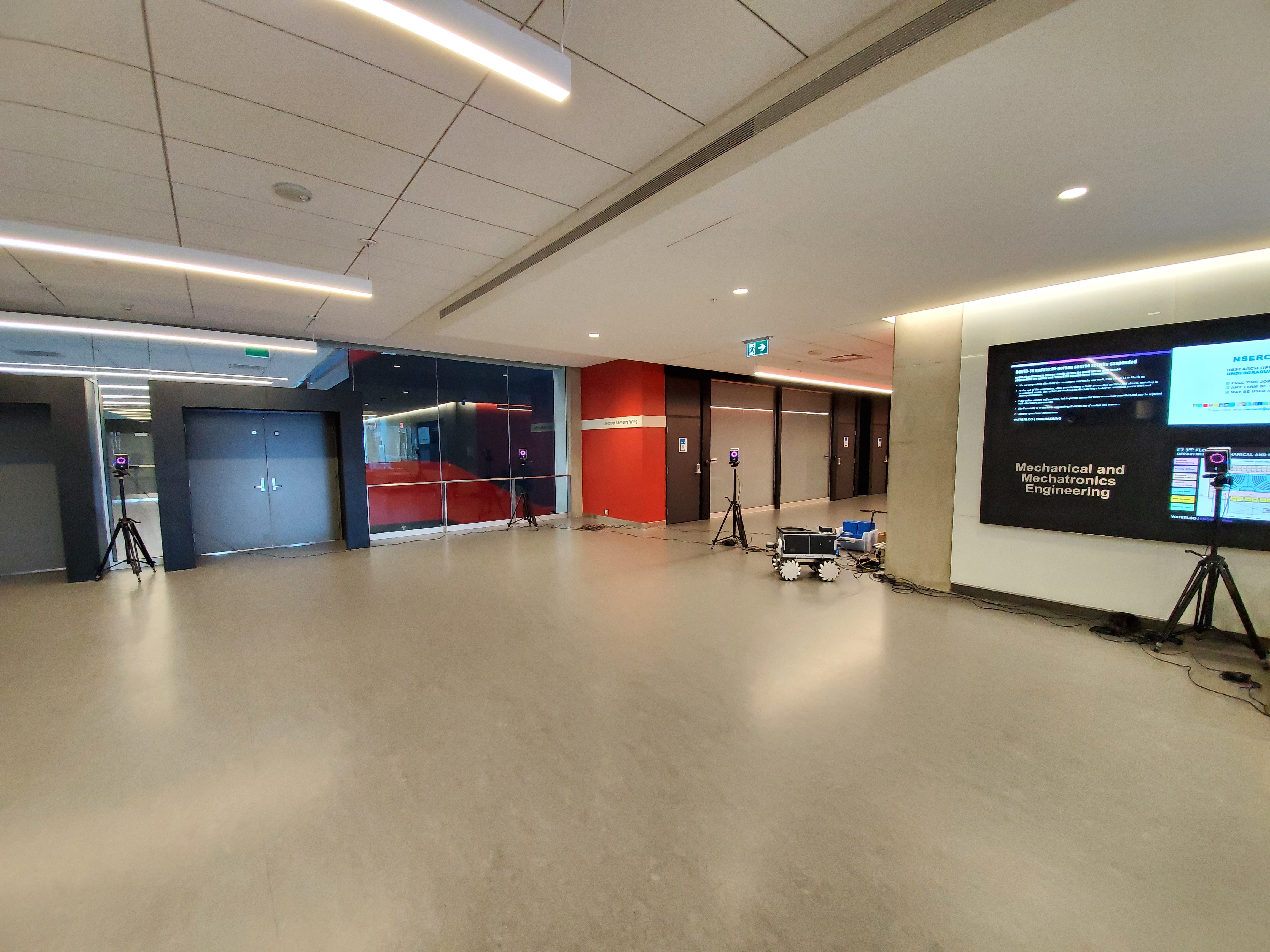
Summit mobile robot operating in a Vicon motion-capture laboratory
Experimental environment used for mobile-robot path-following tests with Vicon motion capture.
ROBOT PLATFORM

Holonomic Summit mobile robot

The Summit platform provides omnidirectional motion, allowing translational and rotational motion to be controlled independently during path-following experiments.

LOCALIZATION

Vicon motion capture

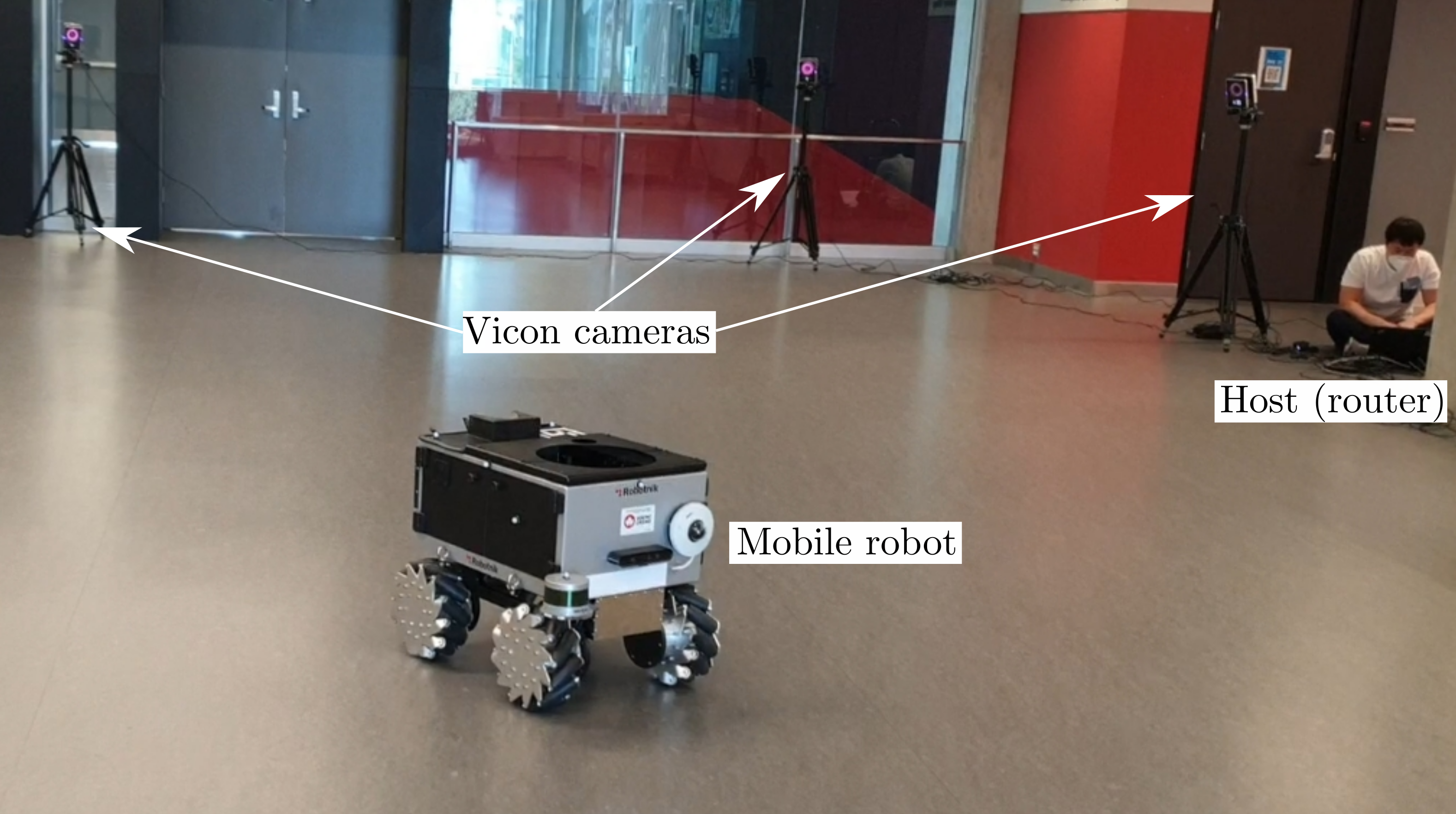
Multiple Vicon cameras were used to measure the robot pose externally and provide accurate feedback for closed-loop control and experimental evaluation.
System Integration

Robot, motion capture, and networked control

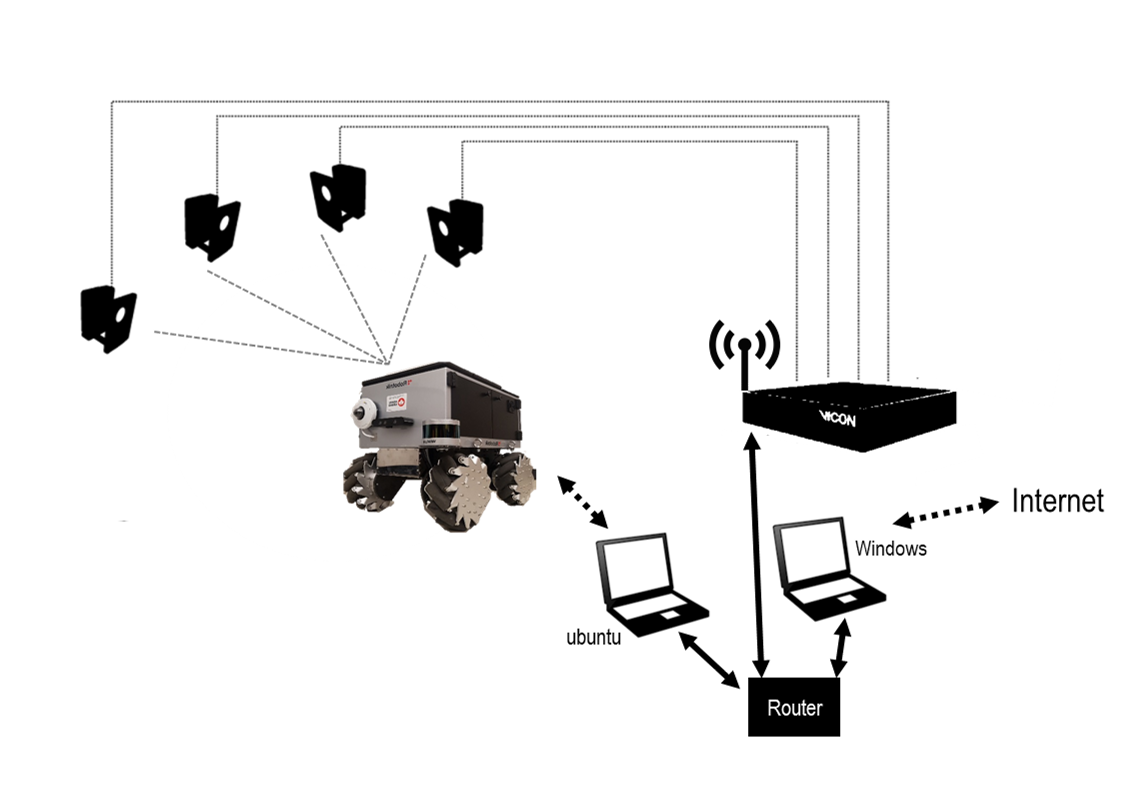
The experimental system integrated the physical robot, Vicon motion-capture cameras, control computers, and network infrastructure into a closed-loop robotics test environment.

Vicon measurements provided the robot pose required by the controller, while the control computer generated commands for the Summit platform over the local network.

Experimental components

  • Summit holonomic mobile robot
  • Multiple Vicon motion-capture cameras
  • Vicon tracking host
  • Ubuntu-based control computer
  • Windows-based Vicon workstation
  • Local network and router
Annotated experimental setup with Summit mobile robot and Vicon cameras
Experimental setup showing the Summit mobile robot, Vicon cameras, and host system.
System Architecture

Closed-loop experimental infrastructure

Robot motion, external localization, and controller computation were connected through a networked experimental architecture.

System architecture of Summit robot, Vicon cameras, Ubuntu computer, Windows host, and router
System architecture connecting the Summit robot, Vicon motion-capture system, control computer, Vicon workstation, and network router.
Control Structure

MPC-based path following

The controller used the measured robot pose together with a reference path to repeatedly compute motion commands over a finite prediction horizon.

At each control update, the measured state was fed back to the controller and the optimization problem was resolved using the current robot configuration.

Robot state

The planar robot configuration was represented by:

x = [x, y, θ]T

where x and y represent planar position and θ represents robot orientation.

Closed-loop sequence

01 Reference Path
→
02 MPC Controller
→
03 Summit Robot
→
04 Vicon Pose
→
05 State Feedback
Path-Following Evaluation

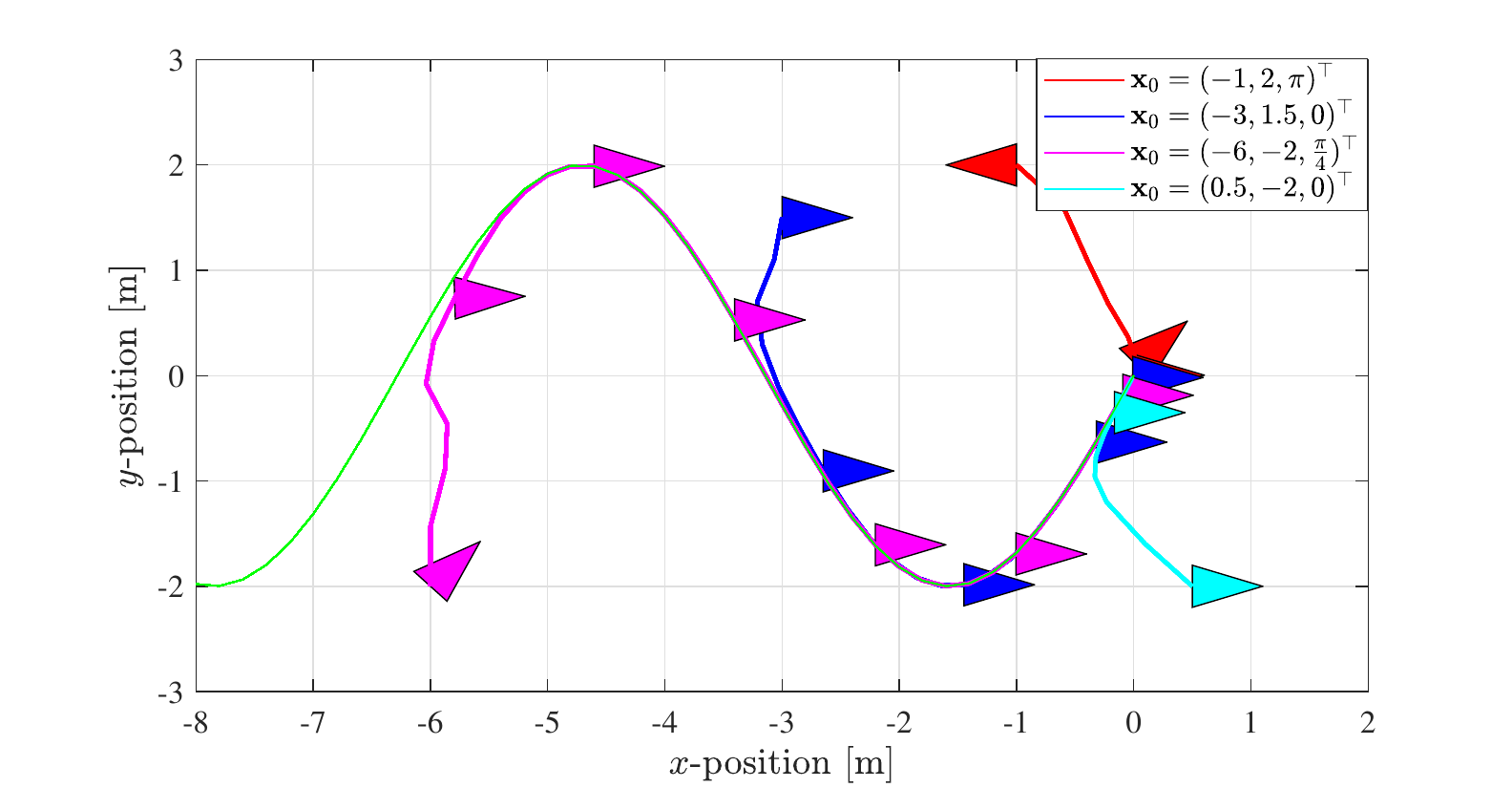
Convergence from multiple initial conditions

Path-following performance was evaluated from multiple initial positions and orientations to assess convergence toward the reference trajectory.

MPC path-following trajectories from multiple initial conditions
Path-following trajectories from multiple initial robot configurations. The trajectories converge toward the common reference path.
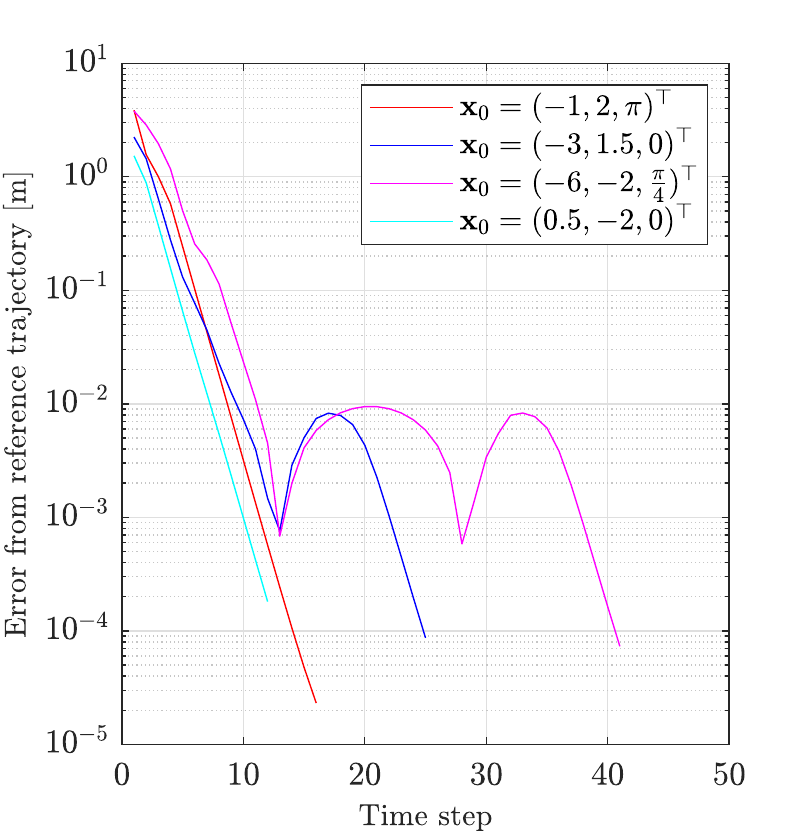
Tracking Performance

Reference-path error convergence

Tracking error was evaluated over time for several initial robot configurations.

Reference trajectory tracking error for multiple initial conditions
Reference-trajectory error for multiple initial conditions. The error decreases by several orders of magnitude as the robot converges toward the path.
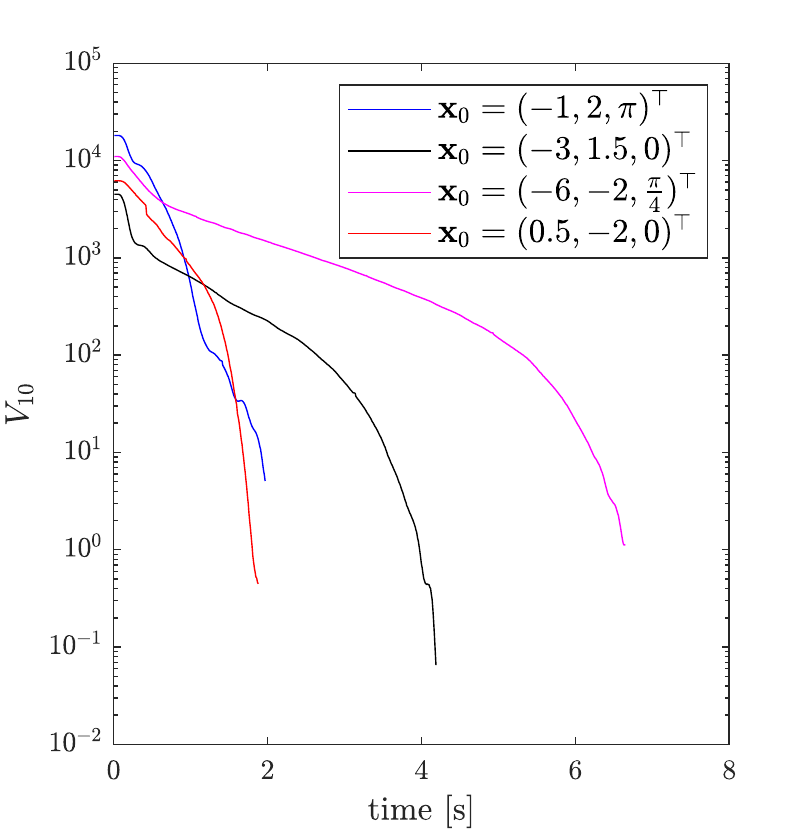
Closed-Loop Behavior

Value-function evolution

The controller value function was monitored during the path-following process for multiple initial conditions.

The observed decrease is consistent with the robot progressing toward the target trajectory under the closed-loop controller.

MPC value function over time for different initial conditions
Evolution of the MPC value function for multiple initial robot configurations.
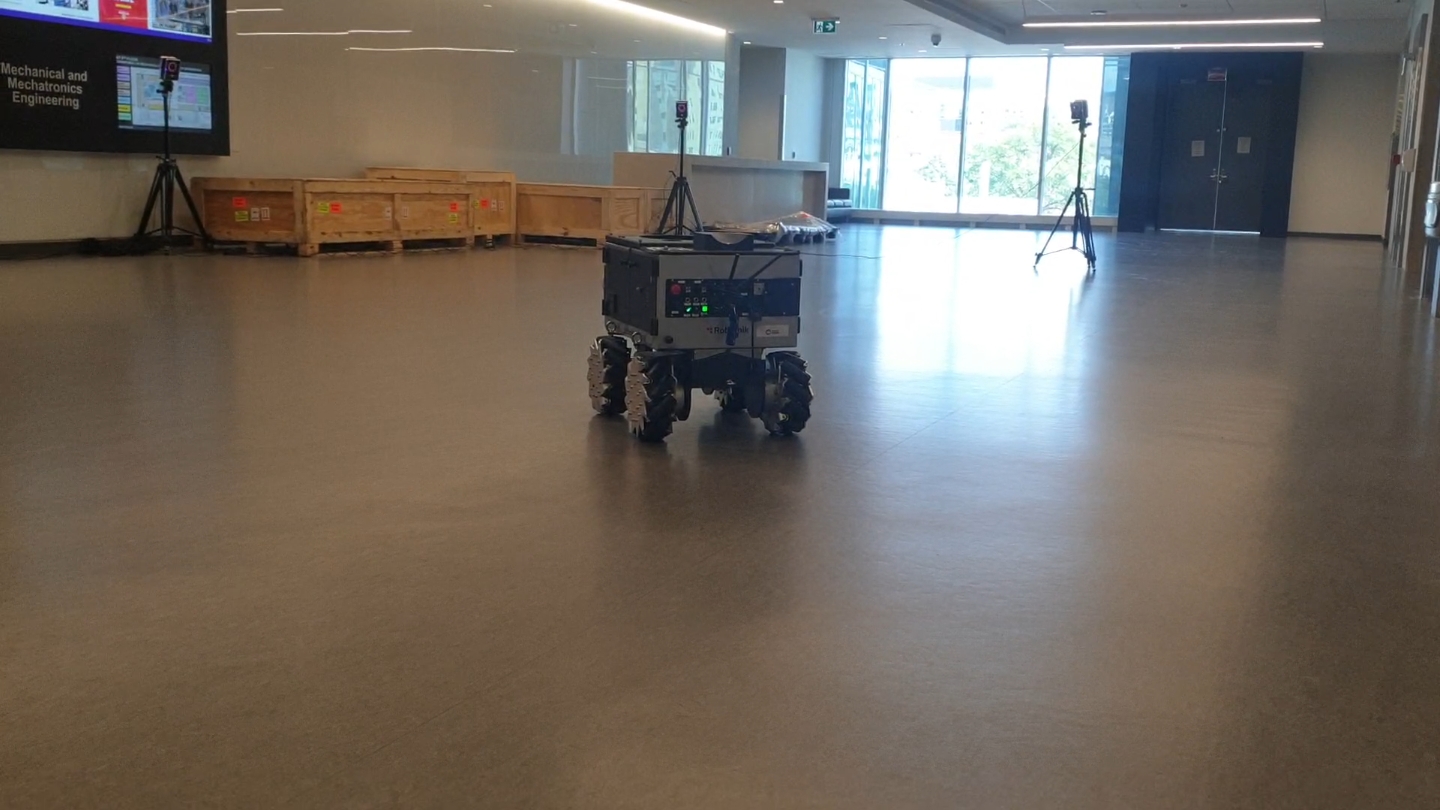
Physical Experiment

Real-robot validation

The controller was validated on the physical Summit platform in the Vicon-instrumented test area.

Summit mobile robot during physical path-following experiment
Physical path-following experiment with the Summit mobile robot in the Vicon motion-capture environment.
Engineering Interpretation

Experimental robotics beyond simulation

The principal engineering contribution of this work was the integration of model-based control with a physical holonomic robot and an external localization system.

Reliable experimental operation required coordination between localization, network communication, controller execution, robot motion, and test-environment configuration.

Practical focus

  • Physical mobile-robot experimentation
  • Vicon-based pose feedback
  • Closed-loop path following
  • MPC controller integration
  • Networked robotics infrastructure
  • Trajectory and error evaluation
← Back to Waterloo Research